Guides
Language
EnglishCurrency
US dollar · $GetYourGuide shows prices in the currency you choose.
Guide · Great whites
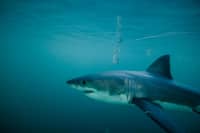
Are there still great white sharks in Gansbaai?
Gansbaai was famous for great whites, then the orcas came. Here is what the research and the operators report, which sharks you are likely to meet now, and how to set your expectations before you book.
Editorial team, sharkcagedivinghermanus.comUpdated October 5, 20267 min read13 sources
Quick answer
- 01Short answer
- Great whites became rare after the orca pair Port and Starboard appeared, but an operator has logged their return to the bay.12
- 02Since when
- The shark absence along parts of the Western Cape was first documented in 2017.3
- 03What you see now
- Boats showcase bronze whaler sharks and other species when white sharks stay away.4
- 04Best months
- June to September has been the best time for great whites at Gansbaai.5
- 05No guarantee
- Sharks are wild animals, so book with flexible terms and a spare day.
What changed in Gansbaai
For years the waters off Gansbaai were famous as a place to see great white sharks from a cage. That picture changed when two orcas known as Port and Starboard arrived on this coast. The absence of white sharks along parts of the Western Cape coastline was first documented in 2017, and the orcas are believed to have hunted the sharks mainly for their nutrient-rich liver.3
The same pair was later seen in the waters off Gansbaai, a busy white shark site about 80km east of False Bay, and cage diving operators reported that white shark sightings plummeted there too.1 For a traveller this is the most important thing to understand before booking: the trip is still real and the sharks are still real, but the classic image of great whites circling the cage on every outing is no longer a safe expectation.
Researchers have documented 11 great white deaths from orcas in South Africa, and a SANParks marine biologist who co-authored the study says the true number is probably higher, because the bodies tend to sink rather than wash ashore.6 That is sobering reading, and it is also the reason good operators now talk openly about what you are likely to see on the day.
Timeline
Great whites at Gansbaai, step by step
-
1991
Protection
South Africa becomes the first country to protect the great white shark.7
-
After 2015
Orcas arrive
Port and Starboard are seen in the waters off Gansbaai.1
-
2017
Sharks go missing
The absence of white sharks along parts of the coast is first documented.3
-
Later years
New stars
Operators showcase bronze whaler sharks and other species.4
-
Recent log
Good news
An operator reports the return of great white sharks to its bay.2
Are great white sharks back?
There is encouraging news. Marine Dynamics, a Gansbaai operator, has reported the return of great white sharks to its bay in its own trip log, alongside other strong wildlife sightings that day.2 A single good report is not a trend, and nobody can promise you a white shark on a given morning, but it shows that the story is not simply over.
The wider population gives some context. A study estimated the South African white shark superpopulation at 908 animals, with a 95% confidence interval of 808 to 1008.8 That is a small number for a coastline this long, which is why the country protects the species. South Africa was the first country to protect the great white shark, in 1991.7
What this means for you is simple: go hoping for a great white, but judge the trip by the whole day at sea rather than by a single species. At check-in, ask the operator about recent great white shark sightings in Gansbaai and what the boats have met over the last few days. The crews are on the water daily and will usually give you an honest picture of recent sightings.
At a glance
Great whites at Gansbaai in figures
| Topic | Figure | What it means |
|---|---|---|
| Protected in South Africa | since 1991 | the first country to do so |
| Orca effect first documented | 2017 | white sharks missing on parts of the coast |
| Orca kills documented | 11 | the real number is probably higher |
| White shark estimate, South Africa | 908 | a small population |
| Seals on Geyser Rock | 60,000 | prey that drew the sharks |
| Best months for white sharks | June to September | clearest water around Dyer Island |
Decision helper
Should you still book the cage dive?
Tap what matters most to you
No trip can promise one; reserve now, pay later and keep a spare day.
Boats showcase bronze whalers and other species near the cage.4
That has been the best time for great whites at Gansbaai.5
Operators link the trips to education and conservation funding.4
Anti-seasickness tablets are strongly recommended for this trip.
After 2015, Port and Starboard were also seen in the waters at Gansbaai, another high-traffic site for white sharks about 80km east of False Bay.
Which sharks you are likely to see instead
When great whites stayed away, the cage diving boats did not stop. Marine Dynamics adapted by showcasing bronze whaler sharks and other species, presenting them as part of ethical tourism that educates guests and funds conservation.4 Bronze whalers, also called copper sharks, are big, bronze-backed sharks that often come close to the cage and give a striking show in clear water.
On a good day you may share the water with several of them at once, and the photographs from recent trips on this tour show exactly that: sleek coppery sharks gliding past the bars and under the boat. For many guests this turns out to be a thrill in its own right, because the sharks are curious and active rather than a distant shape in green water.
Keep an open mind about the rest of the day as well. The boats work close to Dyer Island and Geyser Rock, where seals, seabirds and penguins live, and the trip is as much a marine safari as a shark encounter. If you approach it that way, you will come home with good memories whatever swims past the cage.
Checklist
Before you book in the orca years
Ask and check
- Ask the crew what they have seen this week
- Read the newest reviews before you travel
- Keep a spare day in case the boat cannot go out
- Book with free cancellation
Expect on the day
- A marine biologist explaining the sightings
- Bronze whalers and other sharks near the cage
- Seals and seabirds around the islands
- Breakfast before and lunch after the trip
Video
This was a great white shark hotspot. Then they mysteriously vanished
Tap play and only then does the video load.
Why Gansbaai was the place for great whites
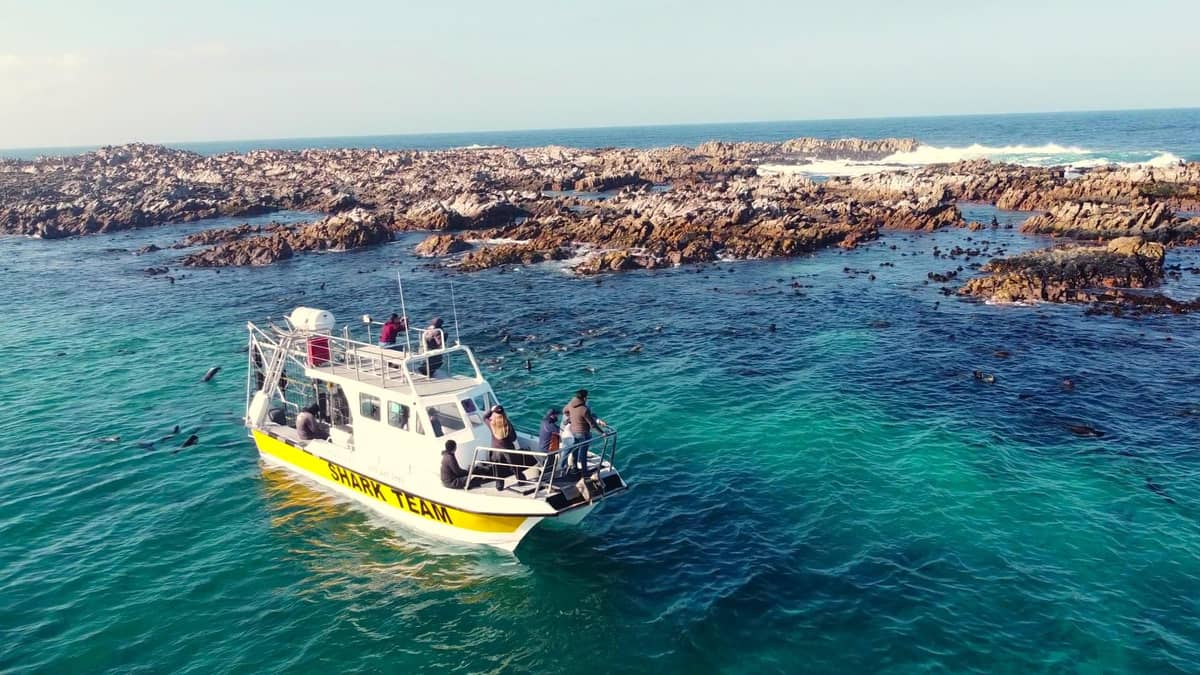
The geography explains the fame. Next to Dyer Island lies Geyser Rock, where a colony of Cape fur seals breeds, and the strip of sea between the islands is called Shark Alley, because the seals feeding there are a constant food source for the sharks.11 Geyser Rock is only 3 hectares in size, yet it holds at least 60,000 Cape fur seals.9
That concentration of prey is what drew white sharks to this corner of the Overberg coast, and it is still why the boats head out to the same waters every morning. The seals are there, the channel is there, and the other species that feed around the islands are there, even in seasons when the great whites are scarce.
Dyer Island matters for other wildlife too. African penguins breed on the island, which was once home to an estimated 25,000 breeding pairs; by 2023 the population had fallen to fewer than 1,000 pairs.10 On the way out you are passing through a fragile and important ecosystem, and that is worth knowing when you sit on deck.
How to set your expectations before you book
Book with the right mindset and the day will feel like a success. You are paying for a morning at sea with experienced crews, a marine biologist and a cage in the water off Kleinbaai, not for a guaranteed great white. The listing for this site's tour describes the trip as viewing an array of sharks from the safety of a cage, which is a fair way to put it.
Pick a date with room around it. In the Cape winter, wind, rain and stormy weather can stop the boats from going to sea, and operators advise setting aside more than one day.12 A flexible booking lets you move if the sea is too rough, and a second chance on a calmer morning also raises your odds of a memorable shark encounter.
Finally, read the latest reviews just before you travel. They tell you more about the current season than any general article, because guests mention exactly which sharks they saw. If great whites have been seen recently, you will find it there first, and you can adjust your plans or your hopes accordingly.
A day without a great white can still be a great day
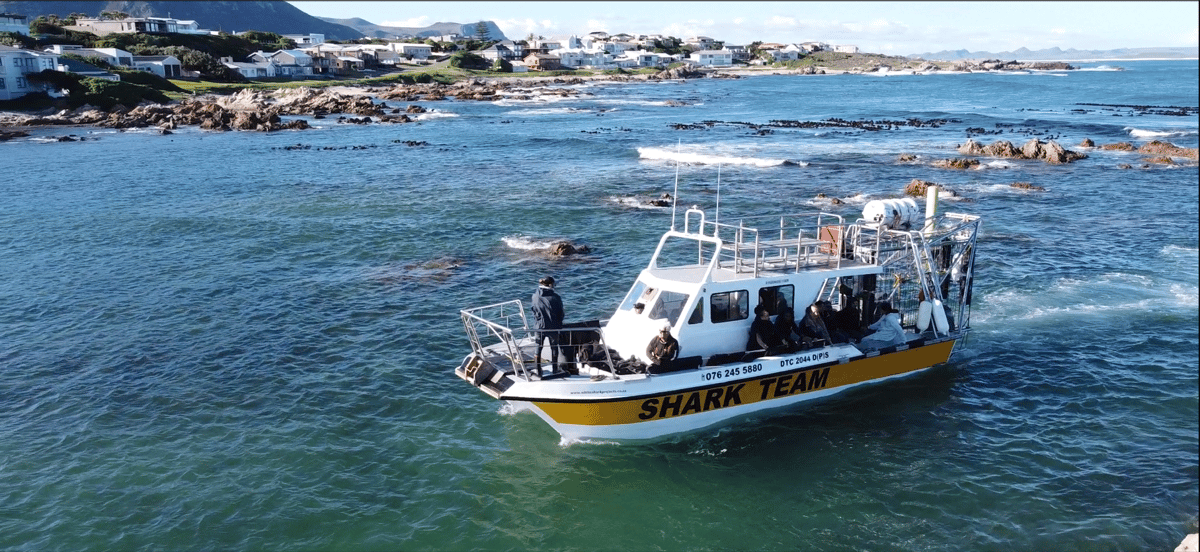
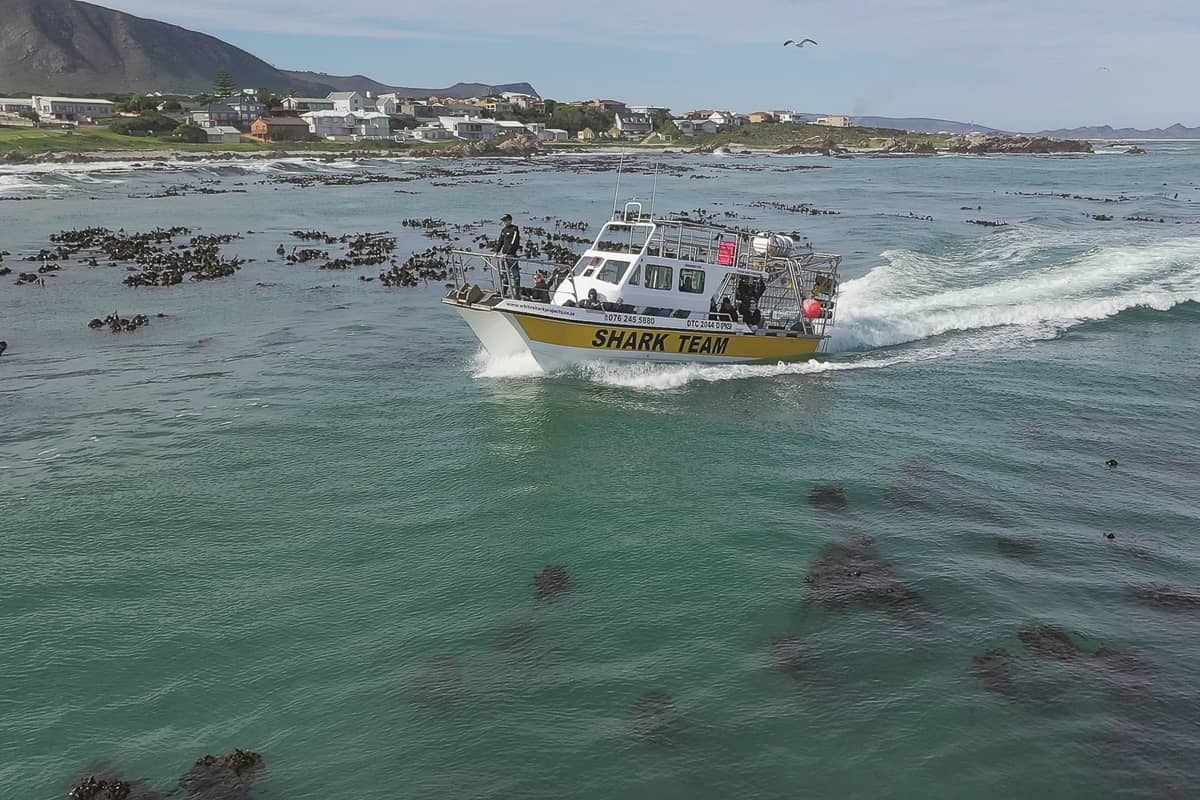
It helps to picture the morning honestly. You arrive at the base in Kleinbaai, eat breakfast, listen to the briefing and walk down to the boat. The ride out is short, the coast falls away behind you, and the crew settles the boat near the islands and lowers the cage. Then the waiting begins, and this is where patience pays off, because sharks arrive on their own schedule rather than yours.
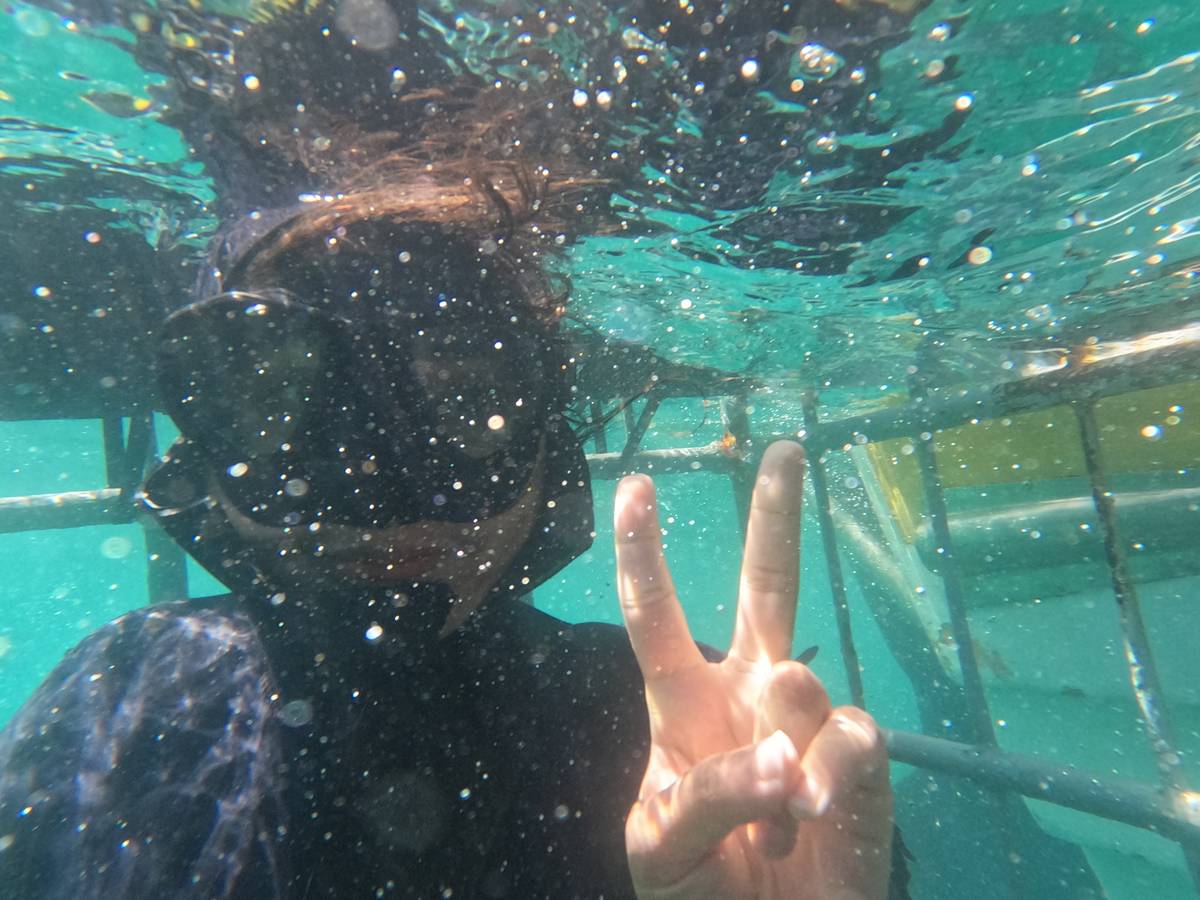
While you wait, there is plenty to watch. Seabirds work the water around the boat, seals pop up and stare back at you, and the marine biologist explains what is happening and why. When a shark does arrive, the mood on deck changes in a second, and the people already in the cage get the best view. The cage holds a few people at a time, so divers take turns in the water.
If the great whites stay away, the bronze whalers often put on a better show than people expect: they are agile, curious and come close to the bars. Many guests leave with photographs and video of sharks at arm’s length, wet hair and a story to tell. That is the realistic version of the day, and it is still a morning worth getting up early for.
What this tour offers in the meantime
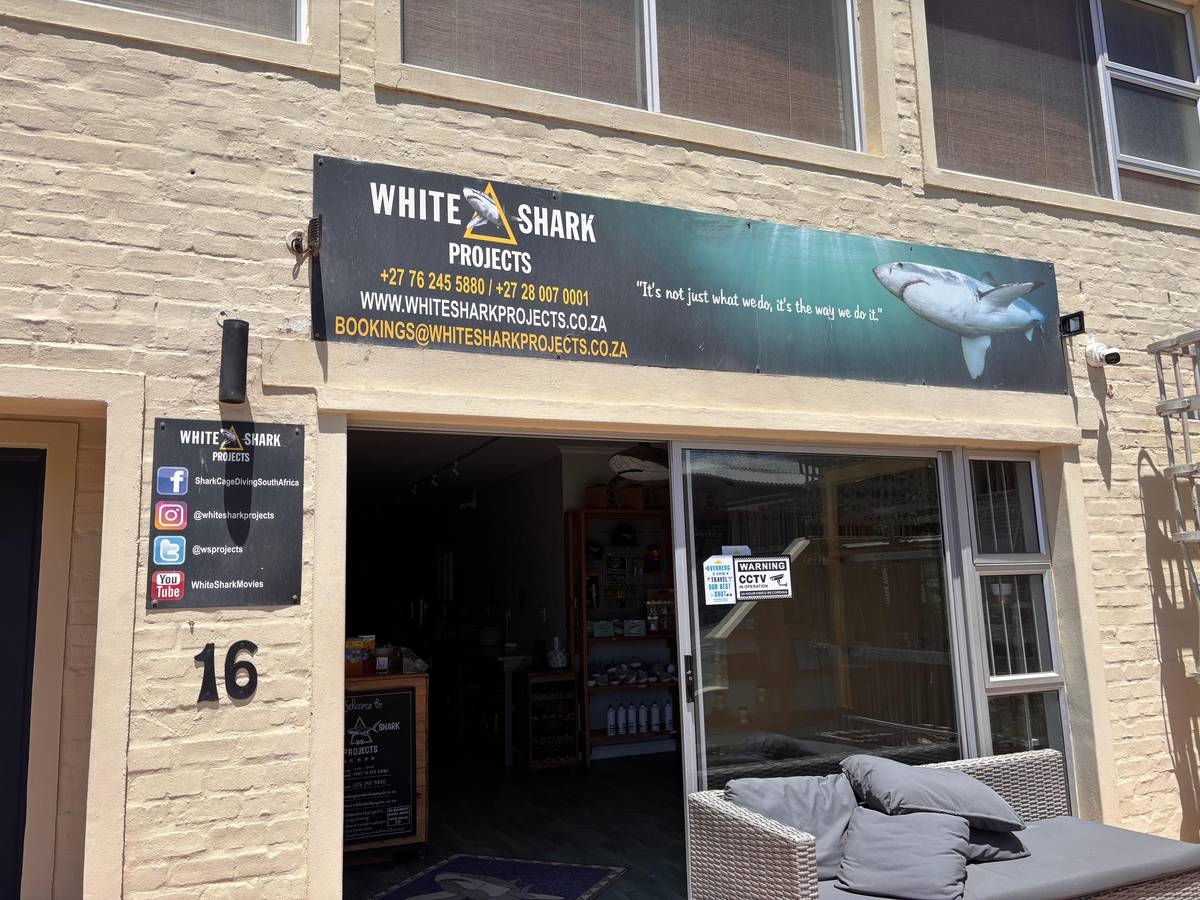
The tour sold on this site is run by White Shark Projects from its base in Kleinbaai near Gansbaai. The company was established in 1989, so the crew has seen the good years and the lean ones.13 You can join from Hermanus or Cape Town, and the full day takes 4.5 to 8 hours depending on where you start.
The day includes breakfast on arrival, a briefing by a marine biologist, about 3 hours on the boat, a cage dive of about 20 minutes with the chance of a second dive, all diving gear, hot showers and a light lunch afterwards. No diving experience is needed, and the guides speak English, Afrikaans and Xhosa.
The tour is rated 4.70 from 818 reviews, and a full refund applies when you cancel at least 24 hours ahead, and you can hold a seat now and pay later. Such flexibility helps on a coast where the weather and the wildlife both have the final say.
Book your dive
A morning at Shark Alley is waiting off Kleinbaai.
Hold your seat today, pay nearer the time, and change your mind at no cost until a day before the boat leaves.


You ask,we answer.
Are great white sharks still in Gansbaai?
Rarely, but they have been seen again. Sightings plummeted after the orcas Port and Starboard arrived, and an operator later logged their return to the bay.12
What happened to the great whites?
Two orcas started hunting them. The absence was first documented in 2017, and the orcas are believed to target the sharks for their liver.3
How many white sharks have orcas killed?
At least 11 documented. Researchers documented 11 deaths in South Africa and believe the real number is higher.6
Which sharks do the boats see now?
Mostly bronze whalers. Operators showcase bronze whaler sharks and other species when great whites stay away.4
Is the trip still worth it?
Yes, if you expect a marine safari. You see sharks from the cage, seals near Geyser Rock and seabirds, with a marine biologist explaining what you see.
When is the best time for great whites?
June to September. That is when the water is clearest and migrating sharks spend time around Dyer Island.5
Are great whites protected in South Africa?
Yes, since 1991. South Africa was the first country to protect the great white shark.7
Sources
Sources and evidence
- 1Nature AfricaOrcas blamed for missing great white sharks↩
- 2Marine DynamicsGreat White Shark↩
- 3Dyer Island Conservation TrustCarcass of Orca predated white shark near Gansbaai, 27 June 2021↩
- 4↩
- 5Marine DynamicsViewing Seasons↩
- 6↩
- 7Marine DynamicsWhite Shark Research↩
- 8PLOS ONE (Public Library of Science)Gauging the Threat: The First Population Estimate for White Sharks in South Africa Using Photo Identification and Automated Software↩
- 9White Shark ProjectsShark Alley↩
- 10Dyer Island Conservation TrustThe African Penguin & Seabird Sanctuary: Ten Years On - From Fledgling to Fully Feathered↩
- 11Marine DynamicsThe Dive Area - Marine Dynamics↩
- 12Marine DynamicsViewing Seasons - Marine Dynamics↩
- 13White Shark ProjectsBook Shark Cage Diving Gansbaai With White Shark Projects↩
Keep reading